


Understanding Your Cat’s Breed Heritage
Have you ever looked at your feline friend and wondered about their cat breeds ancestry? You’re not alone! Many cat owners are curious about the distinctive characteristics and cat breeds that contribute to their pet’s unique appearance and personality. Identifying cat breeds in your furry companion can be both fascinating and informative, providing insights into their behavior, potential health concerns, and care needs.
In this comprehensive cat breed guide, we’ll explore reliable methods to identify the types of cats that might be part of your pet’s genetic makeup. From physical characteristics to behavioral traits, we’ll cover everything you need to know about how to tell cat breeds apart and recognize them in your own cat.
Purebreds vs. Mixed Breeds: What’s the Difference?
Before diving into specific identification methods, it’s essential to understand the distinction between purebred and mixed-breed cats. While purebred dogs are common, purebred cats are relatively rare in the general pet population. According to the Cat Fanciers’ Association, only about 3% of household cats are purebreds, with the vast majority being delightful mixes of various cat breeds.
Without documented lineage or pedigree papers, determining if your cat is a purebred can be challenging. However, DNA testing has made it easier to uncover your cat’s genetic background. Companies like Basepaws offer cat DNA tests that can reveal breed information, though these aren’t necessary unless you’re particularly curious or considering cat shows.
If your cat doesn’t have papers confirming their purebred status, they’re likely a wonderful blend of different cat breeds—often referred to as a domestic shorthair or domestic longhair. Let’s explore how to identify which breeds might be present in your mixed-breed companion.
Identifying Cat Breeds by Physical Characteristics
Coat Length: The First Clue to Cat Breeds
One of the most obvious indicators when trying to identify cat breeds is coat length. Veterinarians typically categorize cats into two main groups based on fur length:
Longhair Cat Breeds
Longhair cats have luxurious, flowing coats that require regular grooming. If your cat has long, fluffy fur that tends to mat or tangle, they likely have longhair breed ancestry.
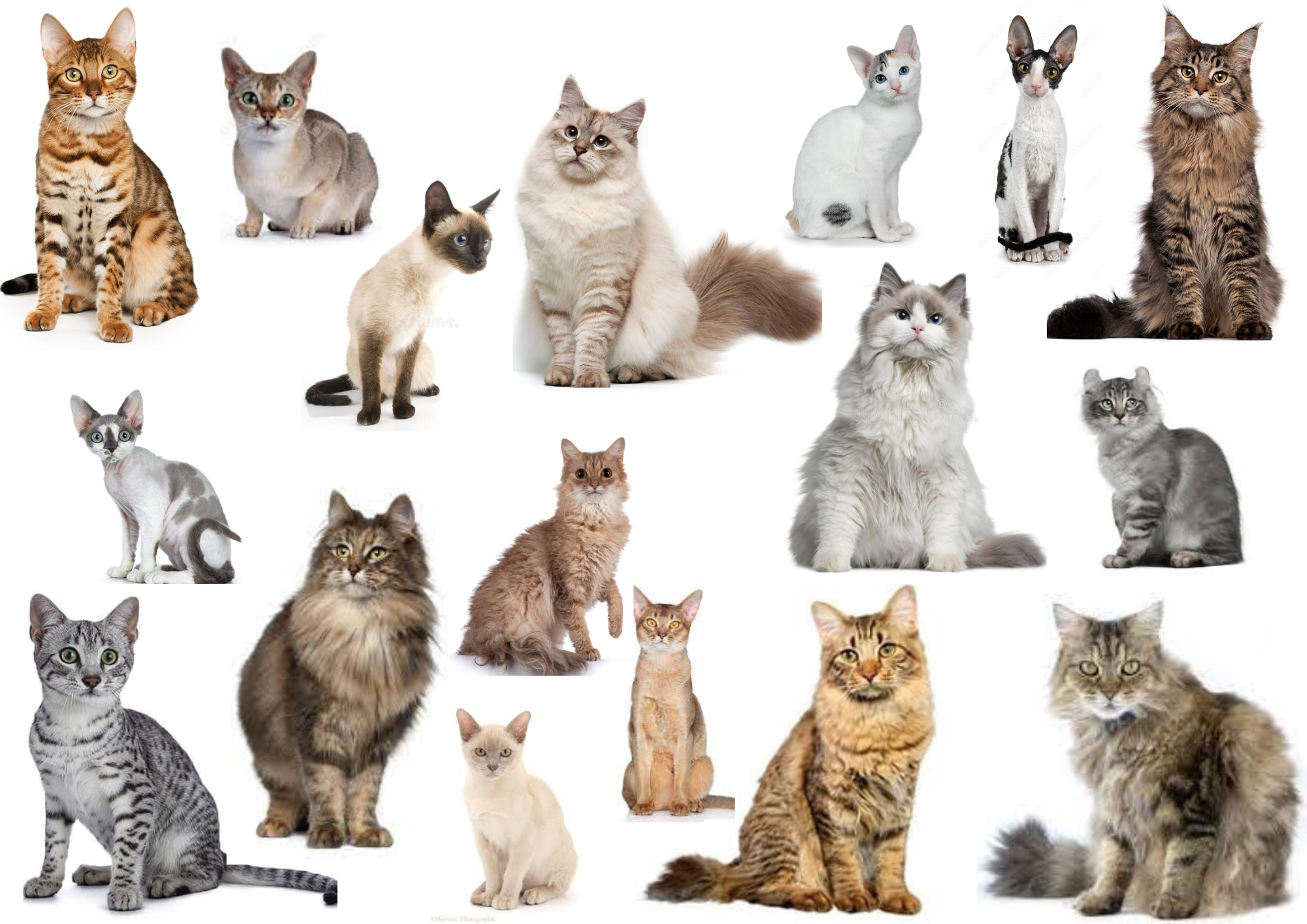
Common longhair cat breeds include:
- Maine Coon (known for their tufted ears and bushy tails)
- Persian (recognized by their flat faces and round eyes)
- Ragdoll (famous for going limp when held)
- Norwegian Forest Cat (with water-resistant double coats)
- Himalayan (Persian-like with color points)
- Birman (distinguished by white “gloves” on their paws)
- Turkish Angora (elegant with silky fur)
Shorthair Cat Breeds
Contrary to popular belief, shorthair cats can still have thick, plush coats—they’re just shorter in length. If your cat’s fur is less than half an inch long, they likely have shorthair breed ancestry.
Popular shorthair cat breeds include:
- American Shorthair (known for their muscular build)
- Siamese (famous for their striking blue eyes and vocal nature)
- Abyssinian (with their distinctive ticked coat pattern)
- Russian Blue (recognized by their silvery-blue coat)
- Bengal (with wild-looking spotted or marbled patterns)
- British Shorthair (known for their round faces and dense coats)
- Burmese (with their satin-like coats and gold eyes)
Size and Body Type: Key Indicators of Cat Breeds
The size and body structure of your cat can provide important clues about their breed heritage. While individual factors like diet can affect a cat’s weight, certain breeds are naturally larger or smaller than others.
Large Cat Breeds
Large breeds typically weigh between 10-25 pounds or more when fully grown. These cats often have substantial bone structure and muscular builds.
Examples of large cat breeds:
- Maine Coon (can weigh up to 25 pounds)
- Ragdoll (typically 10-20 pounds)
- Norwegian Forest Cat (robust with heavy bone structure)
- Siberian (powerfully built with moderately long fur)
- Bengal (muscular with an athletic appearance)
- American Bobtail (substantial with a distinctive short tail)
Small to Medium Cat Breeds
Smaller breeds usually weigh between 5-12 pounds, though some can reach 15 pounds. Despite their smaller stature, they often have distinctive features.
Examples of small to medium cat breeds:
- Siamese (slender with long legs)
- Abyssinian (lithe and athletic)
- Devon Rex (small with curly fur and large ears)
- Cornish Rex (slender with a wave-patterned coat)
- Japanese Bobtail (well-muscled with a rabbit-like tail)
- Singapura (one of the smallest breeds, typically 4-8 pounds)
Coat Patterns and Colors: A Window into Breed History

Coat patterns and colors can offer significant insights when identifying cat breeds. While many patterns appear across multiple breeds, some are strongly associated with specific cat breeds.
Common Coat Patterns in Cat Breeds
Tabby Pattern
The tabby pattern is the most common among domestic cats and appears in many breeds. According to International Cat Care, there are four main tabby patterns:
- Mackerel tabby: Parallel stripes running perpendicular to the spine
- Classic tabby: Swirled patterns forming a “bullseye” on the sides
- Spotted tabby: Spots of varying sizes across the body
- Ticked tabby: Individual hairs with bands of color, creating a salt-and-pepper appearance
Breeds often displaying tabby patterns: American Shorthair, Maine Coon, Egyptian Mau, Bengal, Abyssinian, and Ocicat.
Color Point Pattern
Cats with color points have darker colors on their extremities (face, ears, paws, and tail) while the body remains lighter. This pattern is temperature-sensitive, developing more in cooler areas of the body.
Breeds known for color points: Siamese, Ragdoll, Himalayan, Birman, Balinese, and Thai.
Solid Colors
Solid-colored cats have a uniform color throughout their coat without patterns. Common solid colors include black, white, blue (gray), cream, and red (orange).
Breeds often seen in solid colors: British Shorthair, Bombay (always black), Russian Blue, Korat, and Chartreux.
Bi-Color and Tuxedo
Bi-color cats have white fur combined with another color. Tuxedo cats are a specific type of bi-color with a black coat and white chest, resembling a tuxedo.
Breeds commonly found in bi-color patterns: American Shorthair, Japanese Bobtail, Turkish Van, and Maine Coon.
Calico and Tortoiseshell
Calico cats have three colors: white, black, and orange. Tortoiseshell (or “tortie”) cats have a mottled pattern of black and orange without white. Due to genetics, almost all calico and tortoiseshell cats are female.
Breeds that can exhibit calico or tortoiseshell patterns: American Shorthair, Japanese Bobtail, Maine Coon, Cornish Rex, and Persian.
Distinctive Features in Cat Breeds
Beyond coat and size, many cat breeds have unique physical features that can help with identification.
Head Shape and Facial Features
The shape of your cat’s head and their facial features can be strong indicators of their breed heritage:
- Round heads: British Shorthair, Persian, Exotic Shorthair
- Triangular heads: Siamese, Oriental, Cornish Rex
- Wedge-shaped heads: Modern Siamese, Balinese
- Square muzzles: Maine Coon, Norwegian Forest Cat
- Flat faces: Persian, Himalayan, Exotic Shorthair
Ear Characteristics
Ears vary significantly across cat breeds:
- Tufted ears: Maine Coon, Norwegian Forest Cat, Siberian
- Large ears: Abyssinian, Oriental, Sphynx
- Folded ears: Scottish Fold (due to a genetic mutation)
- Curled ears: American Curl
Eye Shape and Color
Eye characteristics can provide important clues:
- Blue eyes: Siamese, Ragdoll, Balinese (often associated with point patterns)
- Copper or orange eyes: British Shorthair, Persian, Maine Coon
- Green eyes: Russian Blue, Egyptian Mau
- Odd-colored eyes (heterochromia): Turkish Van, Japanese Bobtail, Khao Manee
Tail Types
Tail characteristics vary across breeds:
- Bobtails: Manx (tailless), Japanese Bobtail, American Bobtail
- Bushy tails: Maine Coon, Norwegian Forest Cat, Siberian
- Whiplike tails: Siamese, Oriental, Abyssinian
Comparative Cat Breed Characteristics
| Breed | Size | Coat Length | Common Colors/Patterns | Distinctive Features | Personality Traits |
|---|---|---|---|---|---|
| Maine Coon | Large (10-25 lbs) | Long | Tabby, solid, bi-color | Tufted ears, bushy tail, rectangular body | Friendly, gentle, playful |
| Siamese | Medium (8-12 lbs) | Short | Color point | Almond-shaped blue eyes, triangular head | Vocal, intelligent, social |
| Persian | Medium (7-12 lbs) | Long | Solid, tabby, bi-color, himalayan | Flat face, round eyes | Calm, quiet, sweet |
| Bengal | Medium-large (8-15 lbs) | Short | Spotted, marbled | Wild appearance, muscular build | Active, intelligent, playful |
| Ragdoll | Large (10-20 lbs) | Long | Color point, bi-color | Blue eyes, semi-longhair | Relaxed, affectionate, docile |
| Abyssinian | Small-medium (6-10 lbs) | Short | Ticked tabby (ruddy, red, blue, fawn) | Large ears, slender body | Active, curious, intelligent |
| Russian Blue | Medium (8-12 lbs) | Short | Blue (gray) | Green eyes, plush double coat | Reserved, gentle, intelligent |
| British Shorthair | Medium-large (9-18 lbs) | Short | Blue (gray), various | Round face, dense coat | Easygoing, independent, loyal |
Behavioral Traits in Cat Breeds

While physical characteristics are important, behavior can also provide clues about breed heritage. According to a study published in Scientific Reports, certain behavioral traits have genetic components and may be associated with specific breeds.
Vocal Tendencies
Some breeds are naturally more talkative than others:
- Highly vocal breeds: Siamese, Oriental, Balinese, Bengal
- Moderately vocal breeds: Maine Coon, Japanese Bobtail, Burmese
- Quieter breeds: Persian, British Shorthair, Russian Blue
Activity Level
Energy levels vary significantly across breeds:
- High-energy breeds: Bengal, Abyssinian, Cornish Rex, Oriental
- Moderate energy: Maine Coon, Ragdoll, Japanese Bobtail
- Lower energy: Persian, British Shorthair, Exotic Shorthair
Water Fascination
Some breeds have an unusual affinity for water:
- Water-loving breeds: Maine Coon, Bengal, Turkish Van, Norwegian Forest Cat
- Water-tolerant breeds: Abyssinian, American Shorthair
Social Behavior
Sociability varies among cat breeds:
- Highly social breeds: Siamese, Burmese, Ragdoll, Maine Coon
- Independent breeds: Russian Blue, Persian, British Shorthair
Professional Methods to Identify Cat Breeds
DNA Testing for Cat Breeds
For definitive answers about your cat’s genetic makeup, DNA testing is the most reliable option. Several companies offer cat DNA tests that can identify breed contributions in your pet’s genetics.
Popular cat DNA testing services include:
These tests typically require a simple cheek swab and can identify contributions from various cat breeds and potential genetic health concerns.
Veterinary Consultation
Veterinarians can often provide insights into your cat’s breed background based on their professional experience. While not as definitive as DNA testing, a veterinarian’s assessment can offer valuable information about your cat’s likely breed influences.
Cat Breed Identification Apps
Several smartphone apps use artificial intelligence to suggest possible breeds based on photos of your cat. While these aren’t always 100% accurate, they can provide a starting point for further research.
Featured Snippet: How to Tell What Breed Your Cat Is
To identify your cat’s breed:
- Assess coat length (long vs. short hair)
- Note body size and structure
- Identify coat color and pattern
- Look for distinctive features (ear shape, eye color, facial structure)
- Observe behavioral traits
- Compare against known breed characteristics
- Consider a DNA test for definitive answers
Remember that most cats are mixed breeds, so your cat may display characteristics of multiple cat breeds rather than fitting perfectly into one category.
Embracing Your Cat’s Unique Heritage

While identifying cat breeds in your feline friend can be fascinating, remember that your cat’s unique combination of traits is what makes them special. Whether they’re a purebred or a wonderful mix of different cat breeds, what matters most is the bond you share.
Understanding the potential breed influences in your cat can help you:
- Anticipate possible health concerns associated with certain breeds
- Provide appropriate care based on coat type and grooming needs
- Better understand their behavioral tendencies
- Appreciate the rich diversity of feline genetics
The next time you look at your cat, you might recognize features of a Maine Coon in their tufted ears, or Siamese influence in their vocal nature. Each characteristic tells part of your cat’s genetic story—a living tapestry of feline evolution and domestication spanning thousands of years.
Conclusion: Celebrating Feline Diversity
Understanding cat breeds and identifying them in your own pet can deepen your appreciation for these fascinating animals. Whether your cat displays the distinctive traits of recognized breeds or is a unique blend of many genetic influences, they’re a testament to the incredible diversity within the domestic cat species.
Have you discovered clues about your cat’s breed background? What characteristics make your feline friend special? Share your stories and photos in the comments below!